

Foundations
Part of Seven affiliate marketing foundations for England teams
Before you draft an affiliate marketing market entry checklist
A practical affiliate marketing market entry checklist for small retailers: offer fit, disclosure duties, data sourcing and the pound costs to model before launch.
What to take away
- The most common first mistake is buying platform access before the offer, audience and commission model are defined.
- Entry runs in orderproposition, business model, rules, economics, measurement.
- Disclosure duties follow the audience you reach, not the software you buy.
- For illustration, a small England retailer's first-year commitment can reach about £46,500 once fees, content and commission are counted.
- Tracking and reporting rules need agreeing before the first partner goes live.
Set the programme objective before choosing vendors
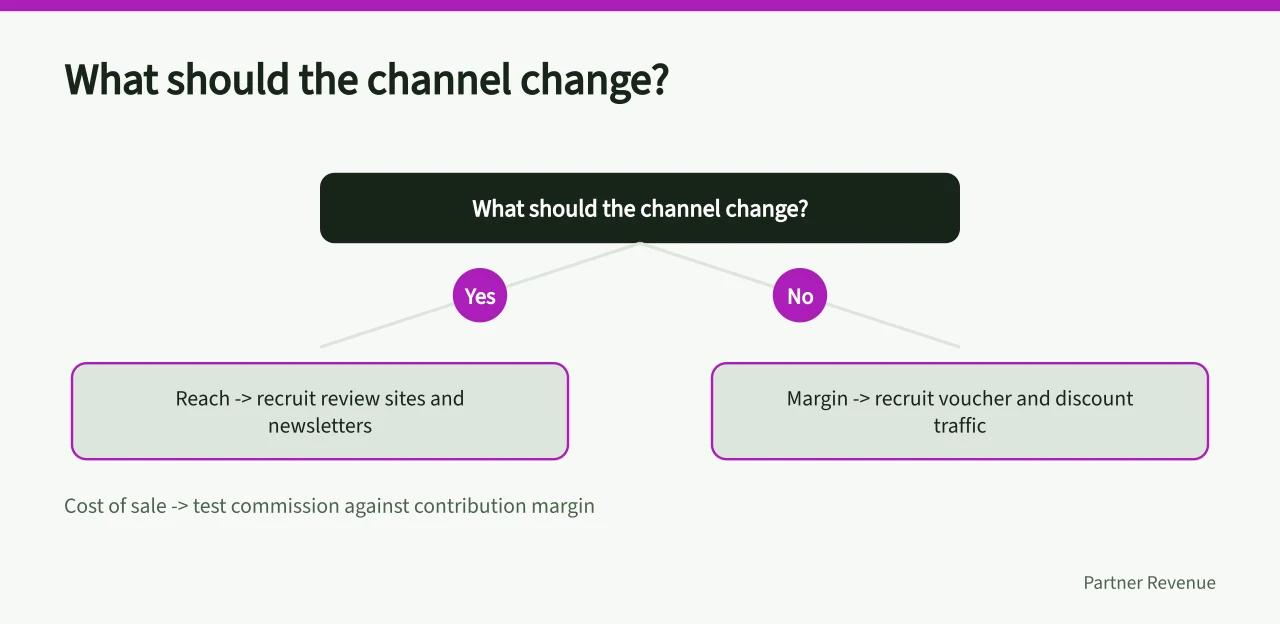
Market entry stalls when the checklist starts with vendor names. The England market guide for 2027 sets out the market scope and definitions this checklist assumes. The first question to settle is what the channel should change: reach, margin, or the cost of a sale.
Commission structure trade-offs
Flat rate
- Behaviour
- Rewards volume
- Best for
- Broad reach
- Risk
- Thin margin
Tiered rate
- Behaviour
- Pushes higher baskets
- Best for
- Margin defence
- Risk
- Complex tracking
The order below is the checklist, with an owner and a target week for each step.
Set the programme objective
- Offertest the commission against contribution margin. Owner: commercial lead, by week one.
- Business modelpick network, in-house or hybrid. Owner: partnerships lead, by week two.
- Rulesconfirm disclosure and consent duties. Owner: legal or compliance lead, by week three.
- Economicsbuild the first-year cost model. Owner: finance lead, by week four.
- Measurementagree tracking and reporting. Owner: analytics lead, by week five.
Define the offer before the partner
A publisher only promotes what pays. Test the commission against your contribution margin after fulfilment, returns and payment fees. If a 10 per cent commission leaves nothing, the channel cannot scale.
The audience story matters as much as the rate. Niche outdoor retailers attract review sites and specialist newsletters, while broad discounters mostly attract voucher traffic. Match the partner type you recruit to the margin you can defend.
Commission structures also shape behaviour. A flat rate rewards volume, while tiered rates push partners towards higher-value baskets.
Choose a business model, then a platform
Networks, in-house partnerships and hybrid arrangements carry different fixed costs and skills. Pick the model first, then the software that fits it. This breakdown of affiliate marketing business models in England explains the trade-offs before you sign a twelve-month contract.
Networks such as Awin and CJ Affiliate provide reach and handle administration; a self-hosted platform such as AffiliateWP keeps tracking in house but needs technical support. Many smaller teams start on a network to reach publishers, then bring their best partners in-house once volumes justify it.
Whichever route you choose, name who owns partner recruitment, who signs the contracts and who answers publisher queries. A model with no named owner tends to stall by month two.
Check the rules before recruiting partners
Disclosure and advertising obligations
The CAP Code requires marketing communications to be obviously identifiable as advertising, and the ASA applies that duty to affiliate content. Affiliate links need labels a reader can see, not a disclosure buried in terms.
Labels should be visible before a click, not only on the landing page.
US-facing activity sits under a different regime, where the FTC's advertising and marketing guidance treats endorsement disclosure as a live enforcement area.
Data sourcing and consent
Cold outreach to a purchased list is a frequent early error. Read the ICO guidance on organisations using marketing services of data brokers before any list reaches your CRM.
A partner's own consent record matters too. Ask how each affiliate collected its audience, and keep that evidence with the contract.
Keep a register of where each list came from, when consent was given and which lawful basis you rely on. If a broker cannot answer that, the list is not worth the risk.
Model the cost and the measurement
Build a first-year cost model
For illustration, a small England-based retailer might budget £3,500 for platform set-up and £900 a month for programme management. Affiliate content at £600 a month plus a £25,000 commission pool brings the first year to about £46,500.
The £25,000 commission line assumes about £250,000 in attributed sales at a 10 per cent average rate, so test that revenue number first.
Treat each figure as a labelled example, then replace it with your own quotes. Commission is the only line that should grow with revenue.
Ask for quotes in writing, because a management fee quoted as a percentage of commission hides the true fixed cost.
Set tracking and reporting before launch
Agree the lookback window, the de-duplication rules against paid search, and the owner of the conversion pixel before the first partner goes live. Attribution changes after launch undo months of reporting.
Fix a monthly reporting slot as well, so the programme is reviewed on numbers rather than enthusiasm.
Affiliates also need creative in their own formats, which is a content capability rather than a media-buying one. CIM's social media and content marketing training is one route for teams building that skill in-house.
Common questions
How long does affiliate market entry take?
For illustration, allow six to twelve weeks from offer definition to the first partner live. Recruiting enough publishers to move revenue usually takes into the next quarter.
Do we need an affiliate network?
Not necessarily. A network buys reach and removes administrative load, while direct recruitment protects margin and gives more control. A hybrid approach, network for the long tail and direct deals for top partners, is common.
What should month one look like?
Three to five partners, one offer, and a fixed reporting template. Add categories only when the tracking data holds up.