
Tools and providers
Part of Affiliate marketing tools and providers for your programme
Why affiliate marketing tool implementation stalls, and how to finish it
Affiliate marketing tool implementation fails on data, ownership and testing, not features. An England guide with a before and after tracker and breach duties.
What to take away
- Under UK GDPR Article 33, a reportable personal data breach must be reported to the ICO without undue delay and, where feasible, within 72 hours of awareness, unless it is unlikely to risk people’s rights and freedoms.
- Most stalled affiliate marketing rollouts are data problemstracking fields, consent records and reconciliation between network and shop.
- Name one owner for the cutover, one for data mapping and one for post-launch checks, in writing.
- Pilot on a small slice of traffic before switching the whole programme.
- Use the Digital Markets, Competition and Consumers Act 2024 and the CAP Code as design inputs for consumer claims and affiliate advertising.
Why implementation stalls before go-live
The brief is written for the tool, not the programme
Teams buy on feature lists, then find the tool cannot express their commission logic. Feature comparisons rarely survive contact with a live commission structure. Define whether commission is a percentage of sale, a fixed amount or tiered, and whether attribution is last-click, first-click or position-based; record how returns and voucher codes affect commission.
Write the brief around decisions instead: who approves a publisher, how a tenancy is split, what happens when a voucher code is reused. If you still compare suppliers, affiliate marketing software selection in England covers the questions that expose gaps early.
Networks and platforms to consider include Awin, CJ, Impact, Partnerize, Rakuten Advertising and Tradedoubler; this is an example set, not a ranking or feature comparison. For a retailer programme using Awin, the implementation brief should identify which system creates the click reference and order record, who sends transaction outcomes, and how finance will reconcile commission before cutover.
Data mapping is left until the week of cutover
Tracking parameters, order identifiers and consent flags must be mapped field by field. Someone should be able to say where each value is created, stored and deleted. Ask the network and the shop to confirm the same field names in writing.
A test field map might include click_id, order_id, order_value, currency, commission, status and voucher_code; agree the actual names with the chosen network because schemas differ. An illustrative postback could carry click_id=...&order_id=...&order_value=...¤cy=GBP&status=approved; document the consent signal separately and confirm how it is handled in the data flow.
Give the map a version number and an owner, so a change to a postback can be traced to a decision rather than a rumour. Without that discipline, reconciliation becomes guesswork. Finance then loses trust in the numbers, and the rollout gets blamed for a reporting problem it did not cause.
How to run the implementation
Sequence the work in four passes
- Freeze the commission basis and attribution model, including how returns and voucher codes are treated.
- Map the click, order and payout data fields, agree how consent is recorded, and write the test plan.
- Pilot on a limited share of traffic across a mix of partner types.
- Switch over and check tracking, reversals and reconciliation daily for a fortnight.
Each pass has an exit condition: signed-off commission and attribution rules; an approved field map and test plan; a test order finance can trace from click to payout; then a cutover with daily checks assigned to named owners. A slipped pass delays one stage, not the whole programme, so write down what each pass must prove.
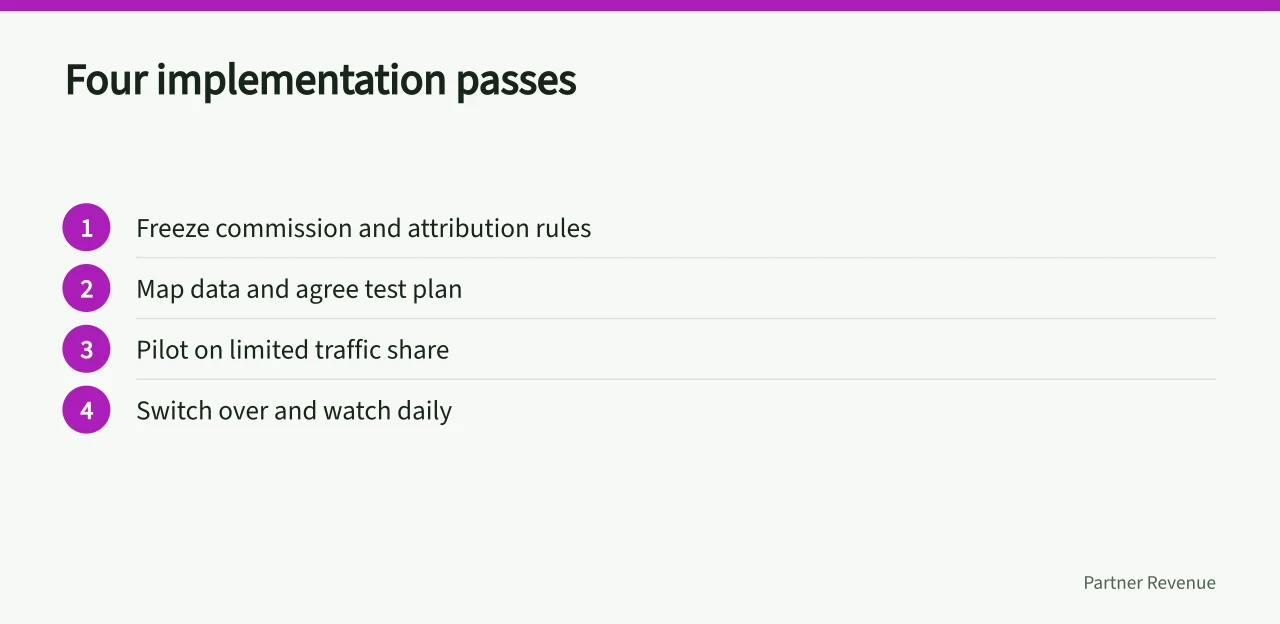
A mapping pass ends when finance can trace one test order from click to payout. A pilot pass ends when reversal rates settle at a level the team can explain. Do not start a pass before the previous one has a signed-off exit note.
Keep the regulator in view
The CMA enforces consumer protection law as well as competition law. Use the Digital Markets, Competition and Consumers Act 2024 as the specific consumer-law reference for price, saving and other commercial claims, and make sure the brief identifies the evidence supporting each claim.
For paid affiliate search ads and publisher content, check the CAP Code, administered by the ASA. Section 2 covers recognition of marketing communications and Section 3 covers misleading advertising; require affiliates to make commercial content identifiable and keep evidence for price or saving claims. Give partners approved wording and clear rules for paid search on your brand terms.
A tracking pixel or postback can carry identifiers. For a reportable personal data breach, UK GDPR Article 33 requires notification to the ICO without undue delay and, where feasible, within 72 hours of awareness, unless the breach is unlikely to risk people’s rights and freedoms. Use the ICO’s online “Report a personal data breach” form; the affiliate marketing operations and delivery guide covers practical runbook details.
What good looks like after cutover
Before and after
Before go-live
- Ownership
- Vendor leads, brand observes
- Tracking
- Parameters agreed verbally
- Testing
- One end-to-end pass
- Reporting
- Vendor dashboard only
- Compliance
- Copy approved ad hoc
After go-live
- Ownership
- Named brand owner for each feed
- Tracking
- Documented field map, versioned
- Testing
- Daily checks for 14 days
- Reporting
- Reconciled view in finance
- Compliance
- Claims checklist per partner
Use the table as a review agenda, not a scorecard. The point is to catch drift while it is cheap to fix.
Before and after go-live
Before go-live
- Ownership
- Vendor leads
- Tracking
- Verbal parameters
- Testing
- One end-to-end pass
- Reporting
- Vendor dashboard only
- Compliance
- Ad hoc copy approval
After go-live
- Ownership
- Named brand owner
- Tracking
- Versioned field map
- Testing
- Daily checks for 14 days
- Reporting
- Reconciled finance view
- Compliance
- Claims checklist per partner
Measure the first ninety days
Track approval times, tracking match rates and reversal volumes. Compare them against the pilot baseline rather than the vendor's own dashboard. Book a review at day 30 and again at day 90, and keep the same measures so the trend stays comparable.
A rise in reversals usually means a rule was never explained to partners, so check the partner brief before blaming the tracking. For a wider view of what to measure and when, the affiliate marketing tools and supplier guide for 2027 sets out the reporting layer in more detail.
Common questions
How long should a pilot run?
Long enough to cover a full settlement cycle, which for most programmes means four to six weeks. Shorter pilots hide reversal patterns. Run the pilot across a mix of partner types rather than one large publisher.
Who should own the implementation?
A named person in the marketing team, supported by finance and a technical contact. Vendor project managers coordinate but should not own your data.
What if a partner sends personal data in a feed?
Stop the feed, log what happened, and assess whether notification is required under UK GDPR Article 33. For a reportable breach, use the ICO’s online “Report a personal data breach” form; the risk scenarios guide can help structure the assessment. Keep the log even if you decide the incident falls below the reporting threshold.
Do we need a new contract for the pilot?
Usually not, but check the order form for volume commitments. Pilots that breach a minimum spend clause cost more than the test saves.