

Measurement
How to build affiliate marketing measurement that stands up
A practical UK guide to affiliate marketing measurement: capture, consent, attribution, network reconciliation, reporting and budget controls.
What to take away
- Affiliate marketing measurement is the practice of recording what tracked partner links and codes produce, deciding which partner gets credit, and reporting the sales and costs that follow.
- Reliable capture comes from first-party tracking and server-side postbacks, not from browser cookies alone.
- One written attribution rule, held steady for a full review period, prevents most partner disputes.
- Reporting works best when it is small, fixed in cadence and segmented by partner type.
- Budget decisions should follow measured return after commission, not last-click volume.
Affiliate marketing measurement starts with one plain idea. You record what a tracked link or code produced, then decide which partner gets credit. The result is reported in a form that finance and marketing both accept. Everything below builds on that definition.
Most programmes fail at one of three points. The tracking breaks on a mobile browser. The attribution rule changes mid-quarter. The report is built for a channel manager and nobody else can read it. Fixing those faults is the core of this guide.
How to capture affiliate data properly
Set up tracking that survives real traffic
Start with the link itself. A tracked URL should carry a partner identifier, a campaign identifier and a click reference. If any of those are missing, the click cannot be joined to a later sale.
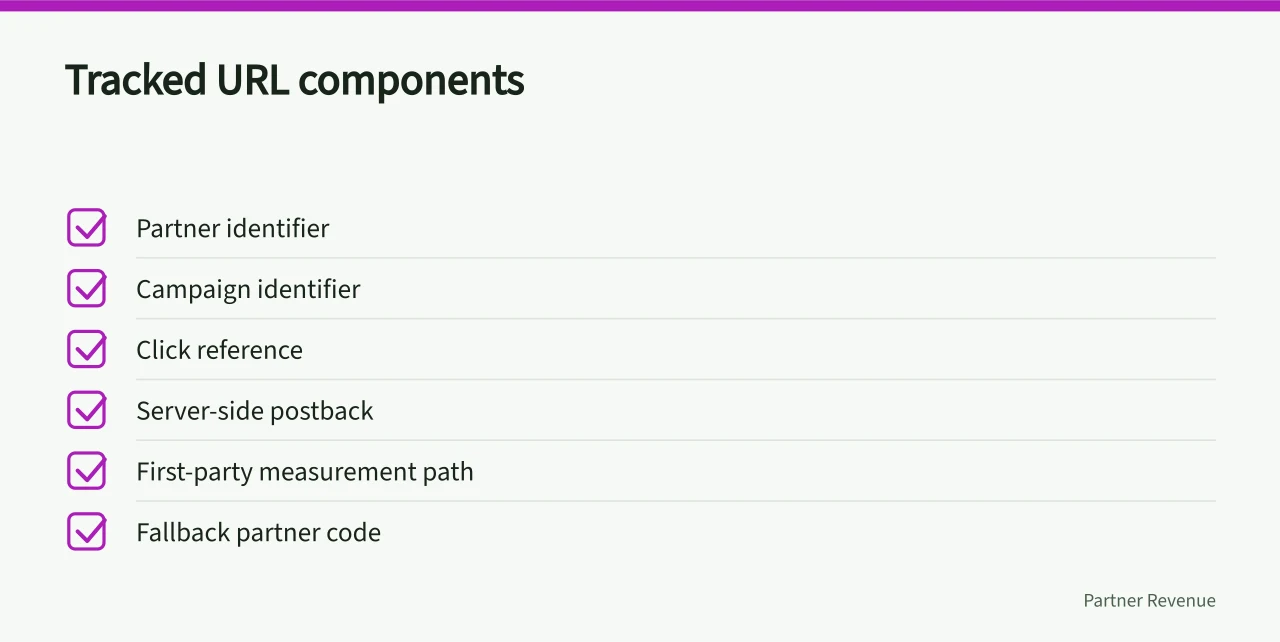
Cookie-based tracking still works for many ecommerce sites, but it breaks when a browser blocks third-party cookies or a customer switches device. Server-side postbacks and a first-party measurement path reduce that loss. The exact method depends on your platform, but the principle holds: send the sale event from your server, not only from the customer's browser.
IAB UK and IAB Tech Lab publish useful advertising measurement guidance and standards. The linked IAB guidance can help when you design event names and agree conversion definitions with networks.
Write down what counts as a conversion before you launch. A sale, a trial sign-up and a newsletter subscription are different events and should not share one field. Track clicks, conversions, sales value, commission, reversals, the date range and the attribution rule so you can explain how each reported result was produced.
Add a fallback for codes. A partner code typed at checkout is a second signal that survives many tracking failures, and it is often the only evidence left when a redirect has stripped a parameter. Decide in advance which signal wins when a click reference and a code disagree.
Deep links need the same care as homepage links. Content and comparison partners usually send traffic to a product page rather than your front door, so the tracking parameter has to survive that redirect. Test each new deep link on a phone before the partner promotes it.
Run a monthly click test across your top partners. Fire one test click each and confirm the order record shows the right identifier. A few minutes of checking catches a broken parameter before it costs a month of commission history.
Where Awin is your network, use its advertiser tracking and transaction reporting as the network-side check: fire a test click, place a test order and confirm the partner and campaign identifiers against your order record. Google Analytics 4 can help compare landing-page sessions with network clicks, but use approved order records for commission reconciliation.
Handle consent and data quality
Apply UK GDPR and the Data Protection Act 2018 to personal data, and PECR to cookies and similar technologies. Under PECR, get consent before storing or accessing information on a user's device unless the technology is strictly necessary to provide a service the user requested; first-party cookies are not automatically exempt. The ICO's guidance on cookies and similar technologies says consent must be freely given, specific, informed and unambiguous, shown by clear affirmative action, and as easy to withdraw as to give; do not set non-essential tracking before consent. The ICO's audits and overview reports can also help you stress-test the wider compliance process.
When a visitor declines non-essential cookies, some measurement may still happen at the point of arrival on your server, but a server-side event does not itself remove PECR or UK GDPR obligations. Decide how you treat that traffic and record the rule rather than letting it vanish from the report without comment.
Data quality is not only a legal matter. If a partner sends traffic through a redirect that strips parameters, your click data is incomplete. Test every new partner link in a private browser window before the campaign goes live.
Keep a log of tracking changes. When a developer alters a parameter name, the historical report will show a sudden drop that looks like partner underperformance. A short change log prevents that false alarm.
Compare clicks with sessions each month. If a partner reports a thousand clicks and your analytics records three hundred sessions, the gap usually comes from a slow landing page, a redirect or a bot filter. Each cause has a different fix.
Hold your own copy of the data. Networks change reporting interfaces and export formats move with them. Archive transaction and click records alongside your own order data so the history remains intact when a platform is redesigned.
How to choose and run attribution
Pick one rule and apply it consistently
Attribution is the rule that decides which partner is credited when several touchpoints appear in one customer journey. Common options include last click, first click, linear and position-based. None is objectively correct. The mistake is switching rules without telling anyone.
Attribution model trade-offs
Last click
- Voucher partners
- Usually favoured
- Content publishers
- Often disadvantaged
- Best for
- Voucher programmes
Position-based
- Voucher partners
- Less favoured
- Content publishers
- Often suited
- Best for
- Content-led programmes
If you run a voucher or cashback partner alongside content publishers, last click will usually favour the voucher site. Position-based rules often suit content-led programmes better. The method you choose should match the commercial question you are asking.
Last click credits the final touchpoint, first click credits the first, linear divides credit across touchpoints, and position-based gives selected positions a larger share. Compare these rules against the same customer journeys and sales before choosing one; do not treat a model's output as proof of incremental sales.
Record the attribution rule in your partner terms. If a partner disputes a commission decision, the written rule is what settles it. Review the rule annually, and give partners notice before any change takes effect.
Test a new rule before you commit to it. Run a small audience split, with one group measured under the new rule and one under the old. Compare orders rather than clicks, and let the test cover a full purchase cycle.
Cross-device journeys are the hardest case. A customer who clicks on a phone and buys on a laptop can appear as two separate visits. Where you can, join those visits on a logged-in account or a hashed email address rather than on a cookie.
Reconcile network data with your own
Network reports and your own analytics will rarely match exactly. Differences come from time zones, refund windows and how each system defines a valid sale. What matters is that you can explain the gap.
Build a simple reconciliation each month. Compare network-reported transactions with your own eligible orders, quantify the variance and record a reason or investigation status for each difference. Do not treat an unexplained gap as normal; a variance that grows month on month is a signal that something may have broken.
Use this format in a spreadsheet such as Google Sheets:
| Period | Network | Partner | Network transactions | Matched eligible orders | Reversed or refunded orders | Commission approved | Variance reason or status |
|---|
Match transactions using the identifiers available in both records, then label unmatched, reversed and pending items rather than silently excluding them.
The IPA publications and reports include research on advertising effectiveness across digital channels, which is useful context when you argue for affiliate spend against other media.
Refunds and cancellations need a defined window. If the network reverses commission after 60 days but your returns policy allows 90, the numbers will drift for a month. State the window in partner terms and report against it consistently.
Commission statements should reconcile as carefully as the marketing data. A payment run that does not tie to the approved transaction report is a control weakness, whatever the channel figures say.
Track new customers against returning ones. A partner that brings a first-time buyer is worth more than one that takes credit for a sale that would have happened anyway. That distinction feeds directly into the commission rate you can justify.
How to report, benchmark and budget
Build a dashboard people actually use
A good reporting dashboard is small. It should show commission earned, sales or leads generated, conversion rate, average order value, and the return after commission. Anything else belongs in a secondary view.
Core dashboard metrics
- Commission earned
- Sales or leads generated
- Conversion rate
- Average order value
- Return after commission
Start with one row per partner and reporting period, with columns for partner type, clicks, approved conversions, conversion rate, average order value, commission, sales value and return after commission. Add a definitions tab and show the reporting period and refresh date so readers can interpret the numbers consistently.
Agree a reporting rhythm before you build anything. Weekly numbers suit active programmes with frequent optimisation. Monthly numbers suit smaller programmes and finance reporting. Do not produce both unless someone genuinely uses both.
Segment by partner type rather than listing every partner individually. Content, comparison, voucher and loyalty partners behave differently and should be judged on different targets.
Define every metric in a single line. Conversion rate, average order value and return after commission should mean the same thing in the partner report and the board pack. Definition drift is the most common reason two teams disagree about the same month.
Show the cost line beside the revenue line. A report that lists sales without the commission paid to earn them invites the wrong decision, particularly in the final week of a quarter.
Keep a short changelog tab in the dashboard. When a figure moves sharply, the first question is always whether something changed in the data pipeline rather than in partner performance.
Use benchmarks and budgets with care
Benchmarks are only useful when the comparison is fair. A programme selling high-value furniture will not match the conversion rate of one selling low-cost accessories. Compare within category and within partner type.
Build a baseline from your own prior periods, split by category and partner type, then compare like-for-like groups. Record the period, attribution rule, metric definitions and data coverage alongside each comparison; treat third-party headline figures as context, not as a target.
For market scope, the digital economy statistics from the Office for National Statistics cover e-commerce and online business activity across the UK, which helps when you need to size a category before setting targets.
Budgeting follows measurement. Knowing the return after commission by partner type shows where the next pound goes.
Put network fees, commissions, tracking development, feed management and reporting labour on one budget sheet, with fixed and variable costs separated. That makes it easier to compare total programme cost with measured contribution.
A team paying £400 a month in network fees can use that as an illustrative fixed-cost line, not an industry benchmark. Calculate whether incremental sales cover it using your own contribution per sale after variable costs and commission.
Measure incrementality where the spend is large. A holdout group of postcodes, or a partner paused for a fortnight, shows what would have happened without the commission. Run that test deliberately rather than discovering the answer when a partner goes quiet.
Set commission tiers against measured contribution. A partner that brings new customers at a high average order value can justify a higher rate than one whose sales mostly overlap with paid search.
Review the fixed cost base once a year. Network fees, feed management and tracking development are lines that rarely shrink on their own.
If partners promote car hire, record the compliance-review status alongside the tracking and attribution setup; the consumer law guidance for selling car rentals sets out information and fairness requirements relevant to those promotions. Keep that review separate from conversion measurement so compliance checks are not mistaken for performance data.
Before and after: what changes when measurement improves
The table below is an illustrative scenario, not a market benchmark or survey result. Use your own network and order data to quantify click loss and changes before drawing a conclusion.
Before and after
Before
- Tracking method
- Browser cookies only
- Click loss on mobile
- Noticeable gaps between clicks and sessions
- Attribution rule
- Changed ad hoc when partners complained
- Conversion definitions
- One field for all actions
- Reporting cadence
- Ad hoc requests from finance
- Partner segmentation
- One target for all partners
- Budget decisions
- Based on last-click volume
- Compliance checks
- Reviewed only after a complaint
After
- Tracking method
- First-party cookies plus server-side postbacks
- Click loss on mobile
- Gaps reduced and logged
- Attribution rule
- Written rule, reviewed annually
- Conversion definitions
- Separate fields for sale, lead and sign-up
- Reporting cadence
- Fixed monthly pack with reconciliation
- Partner segmentation
- Targets by partner type
- Budget decisions
- Based on return after commission
- Compliance checks
- Consent and claims checked at onboarding
Common questions
What is affiliate marketing measurement?
It is the process of recording what tracked partner links and codes produce, deciding which partner receives credit, and reporting the resulting sales, leads and costs. It covers tracking setup, attribution rules, reconciliation, and the reports shared with finance and partners.
How often should affiliate reports be produced?
Most programmes should reconcile network data with their own order data monthly. Active programmes that optimise weekly will also want a lighter weekly view. Whatever cadence you choose, keep it fixed so trends stay comparable over time.
Do affiliate sales need to match network reports exactly?
No. Small differences are normal because of time zones, refund windows and differing definitions of a valid sale. What matters is that you can explain the gap and that it stays stable rather than growing.
Which attribution model is best for affiliate marketing?
There is no single best model. Last click suits programmes where the final touchpoint drives the decision. Position-based or linear models often suit content-led programmes better. Choose one that matches your commercial question and apply it without switching mid-quarter.
In this guide
- Affiliate marketing key metrics without the vanity numbersA practical guide to the affiliate marketing key metrics that matter, with a scoring rubric for English retailers, plus reporting and compliance pointers.
- Why your affiliate marketing reporting dashboard disagrees with financeWhy an affiliate marketing reporting dashboard can differ from finance: network validation, settlement timing, VAT and accounting recognition.
- Seven affiliate marketing attribution methods UK teams can choose fromSeven affiliate marketing attribution methods, from last click to incrementality testing, explained with what each credits, UK consent rules and how to choose.
- Affiliate marketing measurement mistakes explained for UK teamsEight affiliate marketing measurement mistakes UK teams make, plus a decision table and practical fixes for attribution, consent tracking and reporting.
- Affiliate marketing benchmark research rarely settles a performance argumentHow to commission and read affiliate marketing benchmark research without misleading comparisons, covering sample design, disclosure and the evidence you need.