Rules and ethics
Ecommerce advertising rules: check claims, offers and affiliate links first
Review store claims, offers, affiliate links and promotions against current UK advertising and consumer records before measuring any response.
Review the message before its click rate. An ecommerce page can combine the seller's claim, a paid placement, an affiliate recommendation, customer reviews and a prize promotion. This pre-publication review aid was researched on 6 September 2026 and is not legal advice. It requires a named advertising specialist and consumer lawyer for the actual use.
What to take away
- Review the message before its click rate because a page can combine claims, placements, reviews and promotions.
- Each item needs a relationship, evidence and audience record, with a named specialist for actual use.
- A conversion result is not substantiation for product quality, savings or safety.
- Affiliate disclosure must appear with the content and be seen before the user acts.
- The advertising decision does not approve tracking, accessibility or safety.
Classify what the customer sees
- Name the item and placement.Capture the exact headline, image, badge, comparison, review, countdown, price, call to action and destination. Preserve a dated rendering for each device or route in scope.
- Identify the commercial relationship.Record advertiser, publisher, agency, affiliate, seller and any payment, gift, commission or control. CAP Code Section 2 requires covered marketing communications to be obviously identifiable and commercial intent to be clear when it is not apparent.
- Separate editorial work.A supplier document may support a factual statement, but it does not turn a supplier claim into independent evidence. Mark editorial assessment, paid material and unresolved uncertainty visibly in the working record.
Test the claim and offer
- Match evidence to the wording.Keep the claim, product edition, audience, conditions, source, date, owner and expiry together. CAP Code Section 3 includes misleading-advertising and substantiation rules. A conversion result is not substantiation for product quality, savings or safety.
- Review the overall impression.The CMA's unfair commercial practices guidance covers false or misleading information, deceptive presentation, material omissions and commercial intent. Check the sequence, prominence and combined effect, not only whether each sentence is literally true.
- Protect price choice.Use the CMA's price transparency guidance for mandatory fees, taxes and charges. Optional extras need their own active-choice check under the current additional-charge guidance. Do not count a default addition as evidence of preference.
- Verify promotions separately.For a prize, discount or limited offer, record eligibility, significant conditions, availability evidence, closing mechanics and fulfilment owner. CAP Code Section 8 contains the promotional-marketing rules; product-specific sections may also apply.
Make relationships visible at the decision point
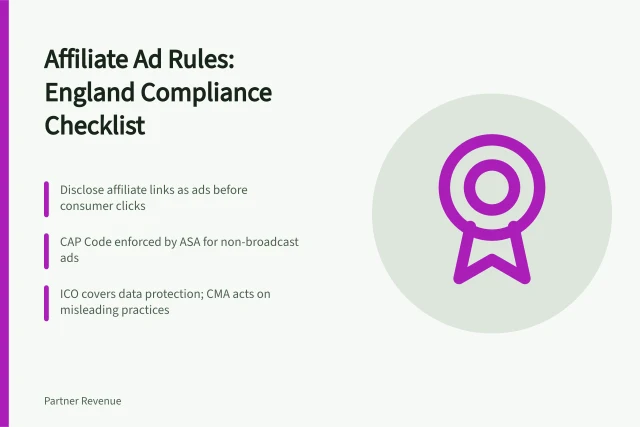
- Place affiliate disclosure with the content.ASA affiliate marketing guidance explains when affiliate-linked content is likely to be advertising. Review wording, prominence and whether the user sees it before acting. A general footer should not be treated as automatic clearance.
- Use clear disclosure wording.A compliant label might read "Ad: we earn commission from links on this page" above the links. A non-compliant approach hides "affiliate links" in a footer or uses a vague "some links may earn us money" without prominence.
- Control reviews and endorsements.Record origin, permission, incentive, moderation and removal. Never create sentiment, suppress genuine negative material selectively or imply an unverified experience. CMA consumer guidance includes fake-review practices within the current unfair-practices regime.
- Keep platform tools in their place.A platform's paid-partnership label may be an additional control. It does not replace the merchant's assessment of the message or likely impression.
Run the independent gates
The advertising decision does not approve tracking, accessibility or safety. The ICO's storage and access guidance applies separately to relevant tags and device operations. Product warnings and withdrawal decisions remain with the safety owner under OPSS guidance.
The release file needs the final creative, destination, evidence bundle, approvals, expiry, monitoring owner and correction route. Stop if the commercial relationship is unclear, evidence does not fit the claim, price presentation changes materially or a specialist gate is unresolved. This is a review aid, not a universal compliance checklist.
Before you act
- Name the item and placement with a dated rendering.
- Identify the commercial relationship and any payment or control.
- Match evidence to the claim wording and conditions.
- Verify promotions separately for eligibility and fulfilment.
- Place affiliate disclosure with the content, not a footer.
- Run independent gates for tracking, accessibility and safety.
References
Common questions
What should be recorded for each item a customer sees?
Record the exact creative: headline, image, badge, review, countdown, price, call to action and destination. Keep a dated rendering per device or route. Note editorial assessment, paid material and unresolved uncertainty.
How should price presentation be checked?
Check mandatory fees, taxes and charges against the CMA's price transparency guidance. For optional extras, verify active choice under additional-charge guidance. Do not treat a default addition as preference.
What does the release file need before acting?
Before release, assemble final creative, destination, evidence, approvals, expiry, monitoring owner and correction route. Stop if the relationship is unclear, evidence does not fit the claim, price changes materially or a specialist gate is unresolved. This is a review aid, not legal advice.