

Rules and ethics
Part of When to check affiliate marketing rules and ethics before you scale
Affiliate marketing advertising rules: CAP Code disclosure and eight checks before launch
A practical guide to affiliate marketing ad rules for England programmes: CAP Code disclosure wording, eight checks before launch, liability and records.
What to take away
- Affiliate advertising in England runs on three rulebooksthe CAP Code enforced by the ASA, consumer protection law used by the CMA, and UK GDPR supervised by the ICO.
- Every paid affiliate link needs a recognisable ad label before the click, in plain words such as "Ad".
- Brands and publishers can both be liable when a disclosure or a claim fails.
- Substantiation files and approval records settle more disputes than a disclaimer buried in a contract.
- This is general guidance, not legal advice, so live cases need a qualified adviser.
Which rules apply to an affiliate programme
The CAP Code is the rulebook for non-broadcast advertising in the UK. A paid promotional post counts as an ad, whether it appears on a blog, a video or a social feed.
The advertising codes published by the ASA set out the recognition, substantiation and misleadingness tests a programme must design around.
Consumer protection law sits alongside the CAP Code. The CMA can act on misleading commercial practices, and its published cases show the recurring failures: unclear pricing, hidden commercial relationships and unproven claims.
If you are mapping the wider regime, the affiliate marketing rules and compliance guide covers when to check rules and ethics before scaling a programme.
What a disclosure has to do
The label must arrive before the consumer engages with the link. A footer credit or a note in a profile bio comes too late.
It has to use words an ordinary reader understands without pausing. The ASA's advice on affiliate marketing points to labels an audience already reads as advertising. "Ad" is the safest single word.
Video and audio need the same treatment, spoken aloud early in the promotional segment.
Short posts still count. A hashtag buried in a block of twenty tags does nothing.
Example disclosure wordings
These three patterns work across blogs, newsletters and social posts.
- "Adpaid partnership with [brand]." Place it above the first link.
- "Advertising feature, produced with [brand]." Use it for paid editorial-style content.
- "This roundup contains affiliate links and we may earn commission." Use it on comparison pages and gift guides.
Put the label in the first line a reader sees, and repeat it if the post continues after a long scroll.
The eight pre-launch checks
Run these before any England campaign goes live. They map to the failures that ASA rulings raise most often.
- Confirm the commercial relationship is disclosed before the first click.
- Check the label uses plain words rather than a coded hashtag.
- Hold evidence for every factual claim in the creative.
- Re-check prices, savings and stock on the date of publication.
- Record the lawful basis for personal data the tracking collects.
- Collect evidence behind environmental or sustainability claims.
- Document how the link is tracked and attributed.
- Search the publisher against previous ASA rulings.
Pre-launch affiliate compliance checklist
- Disclose commercial relationship clearly and early
- Use plain words like ad or advert
- Substantiate every factual claim
- Check prices, savings and availability
- Confirm lawful basis for personal data
- Support environmental claims with evidence
- Track affiliate links and check ASA rulings
If check five is new ground for your team, the data protection article for England programmes sets out consent and record keeping in programme terms.
Who is liable when an affiliate post breaks the rules
Both sides carry exposure. A publisher that writes the post answers for what it says. A brand that sets the brief or approves the creative shares that responsibility.
| Regulator | Rulebook | Who is exposed |
|---|---|---|
| ASA | CAP Code and the advertising codes | Brand and publisher |
| CMA | Consumer protection law | Brand and publisher |
| ICO | UK GDPR and the Data Protection Act | Brand as controller; publisher as processor or joint controller |
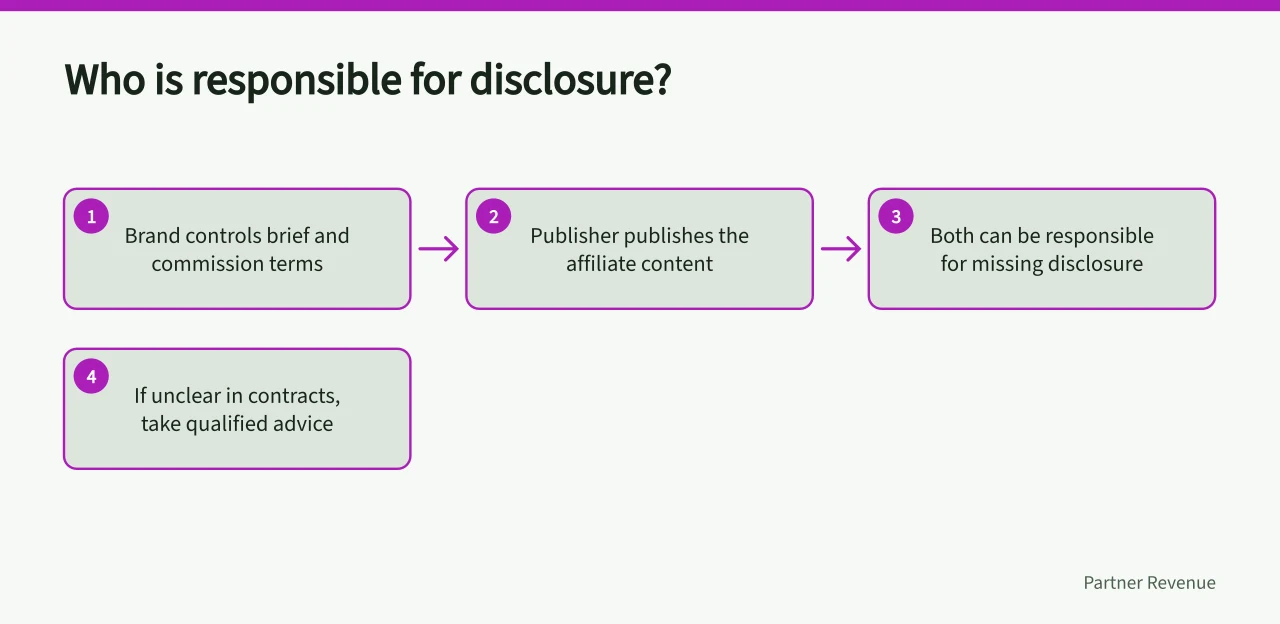
A shared brief does not move liability off either side. It means the evidence trail matters more when a complaint lands.
Data protection and green claims
Cookies, tracking pixels and audience data need a lawful basis and clear information for consumers. The ICO guidance on the GDPR covers lawful basis, consent and security.
Green claims run on the CAP Code and consumer law. Do not let a publisher call a product carbon neutral or eco-friendly without evidence you can produce on request.
Regulators read these claims closely, so a claim you cannot evidence counts as misleading.
Records to keep, and for how long
A workable retention policy: keep the brief, the approved creative, the disclosure wording, commission terms and complaint correspondence for 24 months after the last commission payment on that campaign.
Extend the clock while a dispute, refund or tax question stays open. Where the same paperwork supports tax reporting, follow HMRC record rules rather than the marketing minimum.
A folder per campaign is the baseline, with a named owner on each side. Keep a take-down log too, showing what you removed and when.
Your contract should say who holds which record. The piece on affiliate marketing commercial contracts explains the clauses that make an approval trail enforceable.
Common questions
Do affiliate links always need an ad label?
Yes, where the link is paid and the content promotes a product. Put the label before the click so a reader who is not looking for it still sees it.
Does the CAP Code apply outside England?
It covers the whole UK, though some consumer law and enforcement differ in Scotland, Wales and Northern Ireland. Check regulator guidance if your programme targets those nations.
What should we do if we find a non-compliant post?
Pause the campaign, ask the publisher to correct or remove the post, and log what happened. Take advice from a qualified adviser if the claim is serious or repeated.